Exploring the Portrayal of Elves and Dwarves
Can elves and dwarves be depicted as black? Does the portrayal of dark skin colors, such as dark brown, align with our imaginative perception? Is it justified to modify Tolkien’s work to the extent that it sparks protests in defense of an artist who cannot defend themselves anymore? Or should we respect the new creators’ right to introduce their own vision and evaluate the artistic merit? To what extent should artists have the freedom to reinterpret the work of another creator?
- Musings on Films – Black Elves, My personal opinion
- And what does ChatGPT think about all of this?
- What Art Is About: Love and Hatred Towards the Pope
- Create Your Own Elf: Can Complex Hours-long Photoshoots be Replaced by Exploring the Possibilities of AI?
Full list of black elves’ portraits created so far:
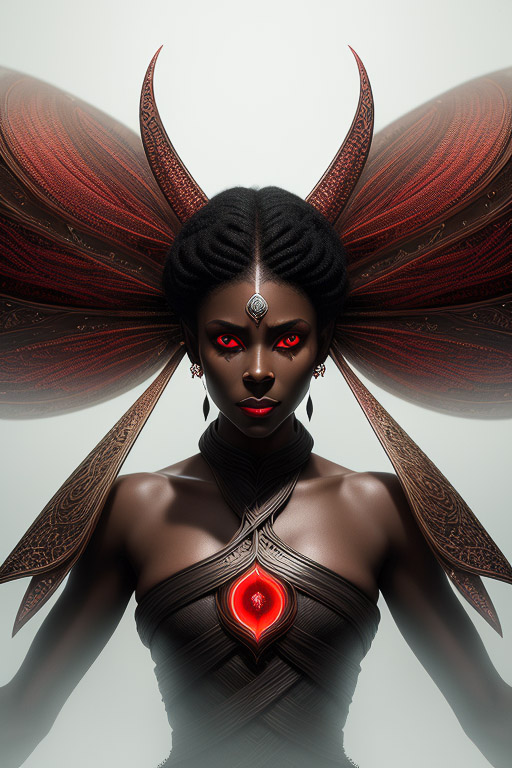
- BLACK ELVES – RED – DEVILS, ANGELS, ABSTRACT
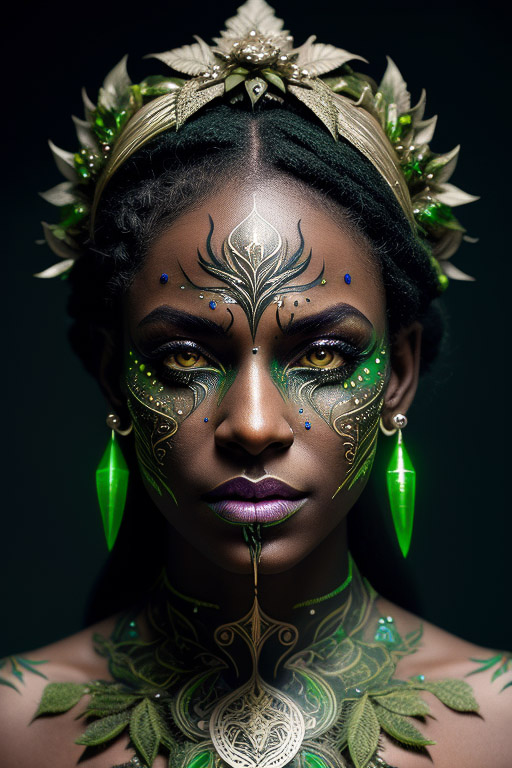
- BLACK ELVES – GREEN – BETWEEN FASHION, FANTASY AND MAGIC
- BLACK ELVES – PURPLE – PART I – SEERS, FAIRIES, WITCHES

GPT Chat:
Depicting elves as black in movies based on Tolkien’s literature would be a departure from the traditional visual representations established in his works and subsequent adaptations. Tolkien’s descriptions often depicted elves as fair or light-skinned.
Introducing diverse representations of fictional races can be a way to promote inclusivity and reflect the diversity of our real-world society.
However, it is important to balance this with respecting the original intentions and established lore of the source material. When making creative decisions, filmmakers need to consider the potential impact on the story, characters, and audience’s perception. Ultimately, it becomes a matter of artistic interpretation and audience reception.

See what AI (GPTChat) has to say about experimentation with Tolkien literature:
GPT Chat:
Depicting elves as black in movies based on Tolkien’s literature would be a departure from the traditional visual representations established in his works and subsequent adaptations. Tolkien’s descriptions often depicted elves as fair or light-skinned.
Introducing diverse representations of fictional races can be a way to promote inclusivity and reflect the diversity of our real-world society.
However, it is important to balance this with respecting the original intentions and established lore of the source material. When making creative decisions, filmmakers need to consider the potential impact on the story, characters, and audience’s perception. Ultimately, it becomes a matter of artistic interpretation and audience reception.


Personally? The series didn’t really impress me, but not because of the “black” elves, but rather due to the slow pace of narrative development, which wasn’t to my liking. However, I do believe that the inclusion of “black” races was actually one of the highlights of the film.
The idea of having diverse races, including both “black” and “white” ones (the White Orc from “Hobbit” was so intimidating!), is something I find as positive experiment.
No courage or lack of artistic freedom?
What I don’t like is that the creators of this series lacked the courage to build their own world with its own mythology, or that they didn’t have enough artistic freedom. Instead, they hid in the shadow of the great classic, who has nothing to say about this kind of interpretation.
(He would probably be disappointed, like most book authors seeing their beloved words transformed into a completely different language, the language of imagery. They often fail to understand and show jealousy towards literature they do not truly respect.
Just think of Philip K. Dick, who was shattered after the premiere of Blade Runner, not recognizing his own narrative. Dick’s novel “Do Androids Dream of Electric Sheep?” has as much to do with Blade Runner as Lucas’ Star Wars has with the USA military cosmic program under the same name.
ART AS a DIALOGUE
But it is the author’s right to sell his work, and it is the new artist, like Ridley Scott, who has the “law of the wolf” to make his own interpretation. Because that’s what art really is: a dialogue. There are classic themes like the Pieta (St. Mary and Jesus) that various artists have picked up over centuries, reinterpreting them and showing their own point of view. That’s how art truly evolves.
A good example is the story of Diego Velasquez’s portrait of Pope Innocent X. The genius painter risked his life to study (by copying on paper!) the drawings of great Italian painters. There was a high chance that Italy and Spain would start a war, and Velasquez, might find himself in a very uncomfortable position. Yet that didn’t stop his ambition to master his technique.
Velasquez is known as the author of one of the most vivid portraits of his time, Pope Innocent X. When the Pope saw himself for the first time in the painting, he supposedly cried, “Too realistic!” He could never be satisfied; nothing was good enough.

The great artist created his portrait with love for the Catholic Church, while many centuries later Francis Bacon approached the same subject for the opposite reason. Francis Bacon despised Christianity and the Pope as its head, in particular. And that’s why he reinterpreted Velasquez’s work. He wanted to say something new but also to express his disagreement with Velasquez, to present his different perspective. That opposition, that friction, created a work so vicious and powerful that to this day it is hard to mention one portrait without discussing its contemporary version.
So, if you want to change classics, have the courage to boldly say something, and you will be remembered forever. But if you do what you did to Tolkien’s text, you will find yourself a victim of debates about the color of the skin of elves while being completely ignored in the realm of artistry. And it’s not a shocker; it’s hard to speak about something that’s absent.
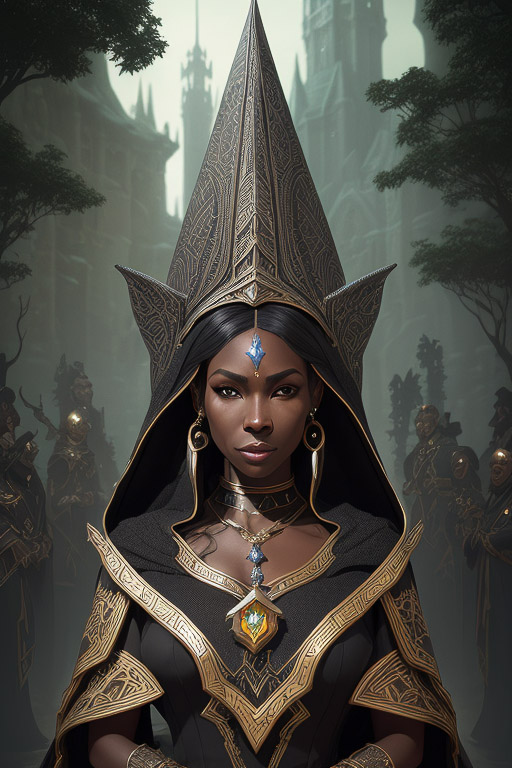
We already know what AI has to say about black elves. Now let’s see what it has to “draw.” There is no better tool for enchantment in our time than electronic media, so let’s harness our imagination and ignite our creativity!
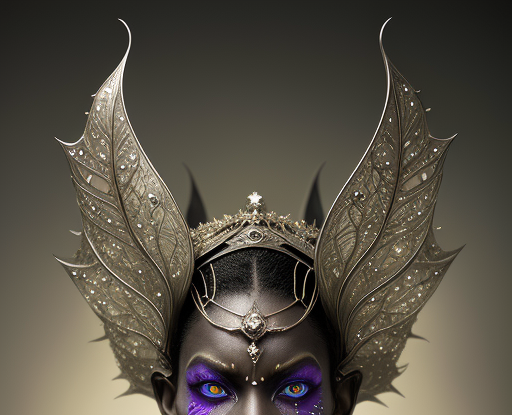
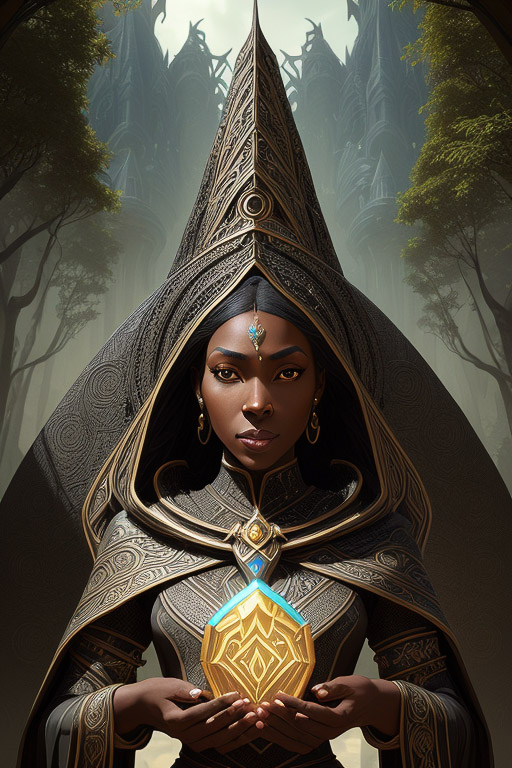
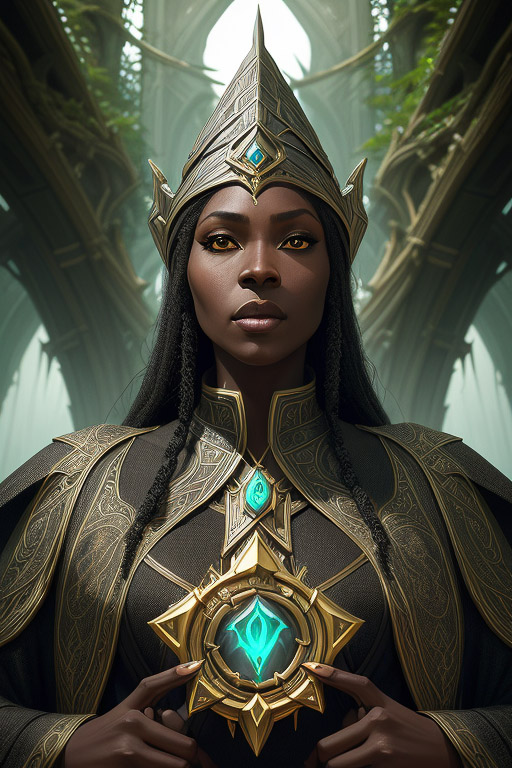
Let’s see if AI can help us create our own version of black elves. I’m putting my computer and imagination to work. As an additional challenge, I aim to create relatively realistic portraits. No paintings, artworks, posters, or drawings.
I want to capture the essence of a living black elven priestess in a professional photograph.
Is it really possible? Instead of renting a studio, hiring or renting a model, doing makeup, searching through friends’ jewelry, and spending hours on concept and design preparations… Can we simply replace all of that with new media supported by AI? Let’s find out!
And so, I begin a series of portraits of black elves, much to the annoyance of all the dwarves. There will be priestesses and warriors, tall elves and forest elves, golden, silver, and all sorts of variations. What unites them all is the fact that they are all black.



 MODDING SIMULACRA
Leave a reply to Black Elves – Red – MODDING SIMULACRA Cancel reply